Table of Contents
01 The Basics of Polyimides
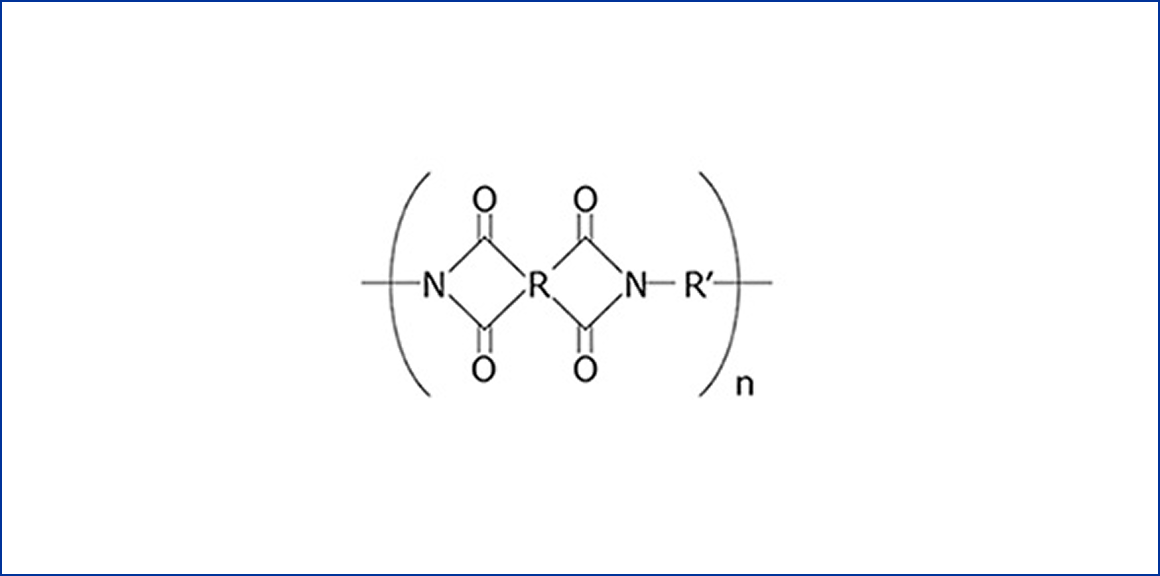
- Polyimide (abbreviated as PI) is a polymer compound containing imide ring bonds (Figure 1) within its molecular chain. Aromatic polyimides, where R is an aromatic group, are widely used in industry.
Figure 1

Polyimide exhibits minimal changes in physical properties within the temperature range of -196 to 300°C. Due to its excellent heat resistance, mechanical properties, electrical insulation, and chemical resistance, it is widely used in applications ranging from aerospace and automotive to consumer Products.
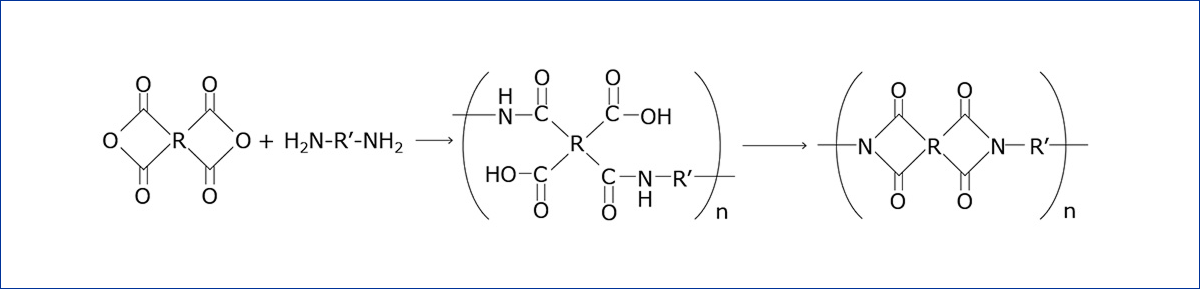
Polyimides are broadly classified into "thermosetting" and "thermoplastic" types. Thermosetting polyimides have a high softening temperature (glass transition temperature: Tg) and are used for coating applications and as film substrates. Thermoplastic polyimides have a Tg of 200 to 300°C. They can be thermoformed and are used for components in various devices.
02 Properties of Polyimides
Polyimides have the following excellent properties.
1. High heat resistance and very high tensile strength at high temperatures.
2. Electrical characteristics (dielectric constant, volume resistivity, etc.) remain almost constant from cryogenic to high temperatures.
3. The heat resistance temperature is considered to be 450°C or higher, providing extremely high heat resistance.
4. Due to the low coefficient of thermal expansion, the thermal shrinkage rate is also low, providing high dimensional stability.
5. They have high thermal conductivity.
6. They have excellent flame retardancy and are more difficult to ignite compared to other polymer resins (such as polyester).
They are insoluble in most organic solvents and exhibit high chemical resistance even at high temperatures.
03 Applications of Polyimides
Polyimides are used in a wide variety of applications by leveraging their characteristics.
In electronic devices, flexible printed circuits (FPCs) are widely used in everything from smartphones to automobiles. They are also used as insulating protective film for motor coils, electrical wires, and semiconductor elements.
In displays, polyimides are used as alignment film to orient liquid crystal molecules in a specific direction for LCDs and as a pixel definition layer for OLED displays.
Polyimide resins are also used as a material for machining, leveraging the mechanical strength, dimensional stability, wear resistance, and low outgassing for applications in semiconductor manufacturing equipment and automotive mechanism parts.
Furthermore, in the aerospace field, their high heat resistance and electrical insulation make polyimides suitable as insulating protective film covering critical equipment such as satellites.
04 Toray Polyimide Products
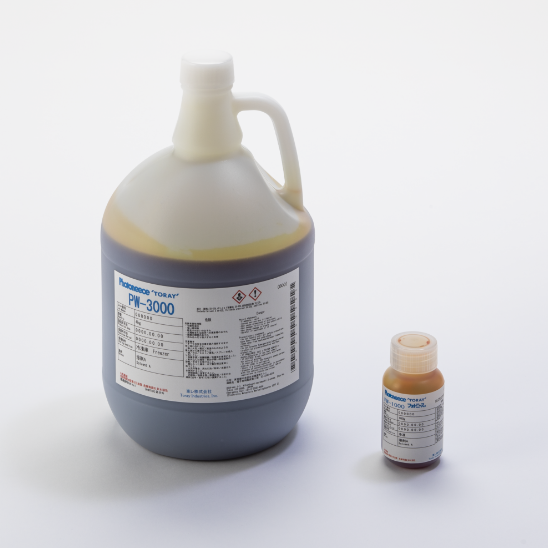
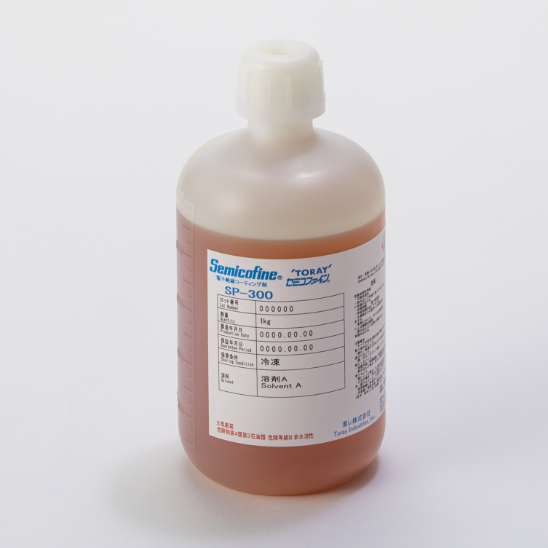
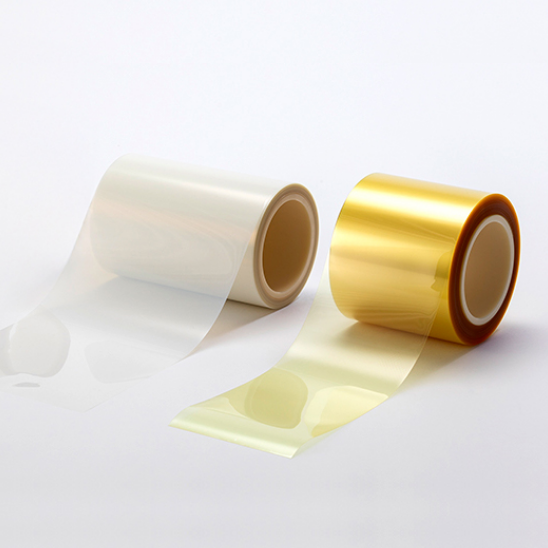
After launching the heat-resistant insulating varnish TORAYNEECE™ in 1970, Toray launched the non-photodefinable polyimide varnish SEMICOFINE™ in 1979 and the photodefinable polyimide varnish PHOTONEECE™ in 1985 for use as protective and insulating films for semiconductor elements. Currently, we offer a wide range of product grades, including varnish and sheet types (FALDA™), as well as non-photodefinable and photodefinable types, which are adopted in various products within the semiconductor, electronic component, and mounting fields. Furthermore, narrow-pitch flexible circuit boards utilizing fine-pattern processing technology are adopted in various displays. Here, we introduce the primary applications.
- Buffer Coating: SEMICOFINE™, PHOTONEECE™
- To prevent cracking or wiring misalignment caused by the difference in thermal expansion coefficients between the molding resin and the semiconductor chip during mounting, polyimides that are flexible, heat-resistant, and exhibit excellent adhesion to resins are used.
- Redistribution Layer (RDL): SEMICOFINE™, PHOTONEECE™
- As semiconductor packages become smaller and more integrated, insulating materials that are capable of fine-scale processing and have excellent mechanical properties are required. Particularly in FO-WLP, adhesion to package encapsulation resins and copper, as well as low-temperature curing, are required.
- Hollow Structure Material: FALDA™
- An increasing number of electronic components with hollow structures, such as MEMS sensors and RF devices, are being integrated into smartphones and automobiles. Polyimides with excellent mechanical properties are used for hollow structure materials; in particular, polyimide B-stage films with high elastic moduli are suitable for forming hollow structures.
- Flexible Circuit Board: Single-sided COF, Double-sided COF
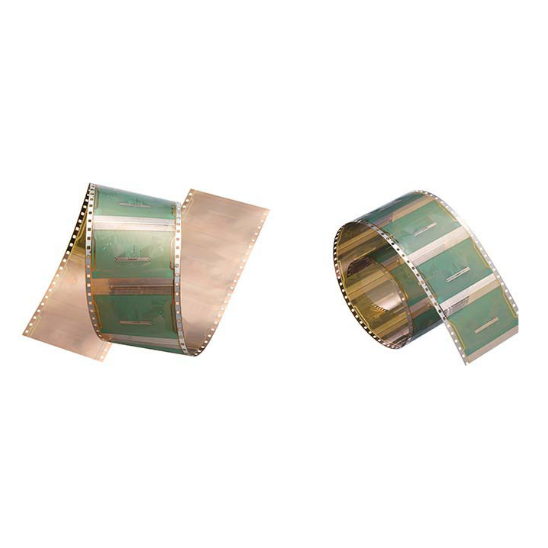
- With the increasing definition of displays, finer wiring patterns are required for flexible circuit boards that implement driver ICs using COF (Chip on Film) technology. Additionally, forming circuits on both sides of the film increases circuit integration density, enabling further miniaturization of the substrate.