PRODUCTS
Plastic Optical Fiber RAYTELA™
Technological Elements


- Toray RAYTELA™ is a multimode/step index plastic optical fiber. Making full use of the lightweight and flexible characteristics of plastic optical fiber, it is widely used in a wide range of fields, including decorative lighting, medical, automotive interior lighting, various sensor applications, and communications.
Applications/Usage
<Decoration/Lighting Applications>
Since optical fibers have no risk of electrical leakage or heat generation, they are ideal for underwater lighting such as fountains and pools, as well as cold lighting for exhibitions. Also, maintenance is easy, so it is widely used for lighting in high locations such as building walls and signs.


Images provided by SAIDEN Corp.


Images provided by PRODUCTS KEI CO., LTD
<Automotive Lighting Applications>
RAYTELA™ can be used for a wide range of automotive interior lighting, including ambient lighting via end-lighting and side-lighting, as well as decorative lighting for door trims and other applications using woven optical fibers.



<Industrial Applications>
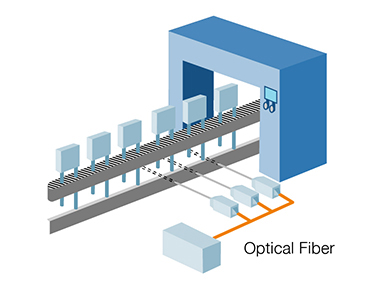
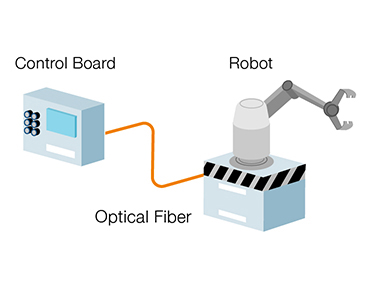
RAYTELA™ can be used for a wide range of automotive interior lighting, including ambient lighting via end-lighting and side-lighting, as well as decorative lighting for door trims and other applications using woven optical fibers.
<Medical Applications>
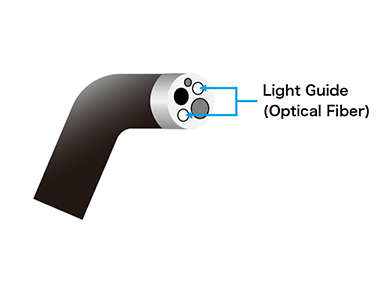
Toray Plastic Optical Fiber RAYTELA® has a significant proven performance in medical applications. Compared to general plastic optical fiber, it features a wide irradiation range, low bending loss, and excellent break-bending properties, and it is adopted for applications such as endoscopes.
Product Information
<Plastic Optical Fiber Strand>
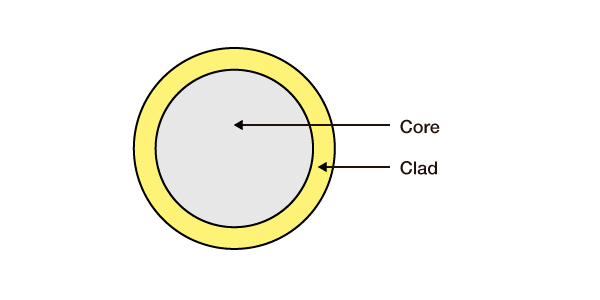
A plastic optical fiber made using high-purity polymethyl methacrylate (PMMA). Fiber diameters are available from 250 μm to 3000 μm.

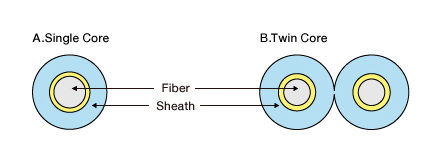
<Plastic Optical Fiber Cord>
Various materials are used for covering, including polyethylene and polyvinyl chloride, to provide heat-resistant, bend-resistant, and chemical-resistant cords with physical/chemical durability.

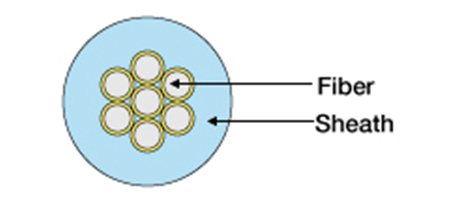
<Plastic Optical Fiber Light Guide>
We offer light guides consisting of bundled and coated optical fibers.
Technology Information
<Product Characteristics>
| PG Type | PS Type | PF Type | PE Type | |
|---|---|---|---|---|
| Core | PMMA | PMMA | PMMA | PMMA |
| Cladding | G | S | F | E |
| Fiber Diameter [μm] | 250 to 3000 | 250 to 1000 | 500 to 1500 | 500 to 1500 |
| Numerical Aperture | 0.50 | 0.46 | 0.46 | 0.55 |
| Transmission Loss @ Φ1.0 POF [@650 nm, dB/km] |
≤ 150 | ≒ 6000 | ≤ 150 | ≤ 150 |
| Heat Resistant Temperature [°C] | 70 | 70 | 85 | 105 |
PMMA: Polymethyl methacrylate
*The above values are representative values and are not guaranteed values.
Packaging Information


Spool Dimensions
<Specifications>
| Spool Type | Dimensions [mm] | Weight [kg] |
Material | |||||
|---|---|---|---|---|---|---|---|---|
| 1 | 2 | 3 | 4 | 5 | ||||
| Fiber | A | 300 | 190 | 52 | 180 | 14 | 1.25 | Polystyrene |
| B | 285 | 195 | 52 | 89 | 7 | 0.58 | ||
| Cord | C | 350 | 210 | 51 | 140 | 3 | 0.98 | ABS |
| D | 450 | 210 | 51 | 140 | 3.5 | 1 | ||
| E | 450 | 315 | 51 | 141 | 3 | 1.2 | Cardboard | |
| Carton Type |
Carton Dimensions (L × W × D) [mm] |
Packaging Spool Type | Package Number (Bobbin) |
|---|---|---|---|
| a | 296 × 110 × 296 | B | 1 |
| b | 305 × 220 × 315 | A | 1 |
| B | 2 | ||
| c | 420 × 310 × 302 | A | 2 |
| B | 4 | ||
| d | 362 × 362 × 172 | C | 1 |
| e | 360 × 315 × 372 | C | 2 |
| f | 461 × 461 × 167 | D | 1 |
| E | 1 | ||
| g | 461 × 312 × 471 | D | 2 |
| E | 2 |
*Please read the following "Handling Precautions" and use correctly.
Handling Precautions
Applicable Products: When handling Toray's plastic optical fiber strand, cord, cable, light guide, and processed products using these (hereinafter collectively referred to as "Toray Plastic Optical Fiber RAYTELA™"), please adhere to the following precautions.
For safe use of Toray Fiber RAYTELA™
1. Application Precautions
- (1) Do not use Toray Fiber RAYTELA™ in applications that come in contact with food or people (including medical applications). To use the product for medical applications, please consult our representative in advance.
2. Design Precautions
- (1) When designing a system that will use Toray Fiber RAYTELA™, please be aware of all characteristic values of Toray Fiber RAYTELA™ in the technical documentation when making the design.
- (2) Furthermore, the characteristic values noted in the technical documentation are not a guarantee of the safety or compatibility of this product. The customer should confirm such safety and compatibility of this product with their intended application.
3. Usage Precautions
- (1) Please use Toray Fiber RAYTELA™ within the temperature range indicated for each grade. In particular, there is a danger of gas generation due to partial degradation and fire if used at temperatures over 200°C.
- (2) When using halogen lamps or concentrated sunlight as a light source, take care that the maximum usage temperature is not exceeded, by using light cut filters or cooling equipment.
- (3) Avoid use in locations with high levels of dust or dirt. If dust or dirt adheres to the end of Toray Fiber RAYTELA™, the optical characteristics will be decreased. Also, at high temperatures there is a danger that the dust may catch fire, causing the Toray Fiber RAYTELA™ to melt/burn.
To best make use of the characteristics of Toray Fiber RAYTELA™
1. Precautions for Mechanical Environments
- (1) Do not apply force above the maximum tolerance.
- (2) Do not use with an unreasonably tight bending radius. In particular, if there is excess stress near the connector attachment point, the optical characteristics may be decreased. Please keep the bend radius above approx. 20 times the outer diameter being used.
- (3) Do not twist Toray Fiber RAYTELA™ excessively. If used while twisted, the optical characteristics may be decreased.
- (4) Please also avoid continuous forced bending and extreme drops.
2. Precautions for Chemical Environments
- (1) Do not allow Toray Fiber RAYTELA™ to come into contact with plasticized polyvinyl chloride materials (electrical wire, vinyl tape, etc.) containing a plasticizer (phthalate-type plasticizers, etc.). The plasticizer will transfer and may decrease the optical characteristics. Please check in advance for reactions.
- (2) Also, thoroughly check the chemical resistance of Toray Fiber RAYTELA™ to cleaning solutions, adhesives, oils, solvents, etc., in the technical documentation.
3. Precautions for Other Environments
- (1) Performance is decreased when used in high temperatures, so make sure to use a cable structure with suitable countermeasures. Take care that excessive water does not get into the Toray Fiber RAYTELA™.
- (2) Also, avoid usage in environments exposed to special energy rays such as UV rays or radioactive rays.
- Applications/Usage
- Product Information
- Technology Information
- Packaging Information
- Handling Precautions
 Product Search
 Contact Us